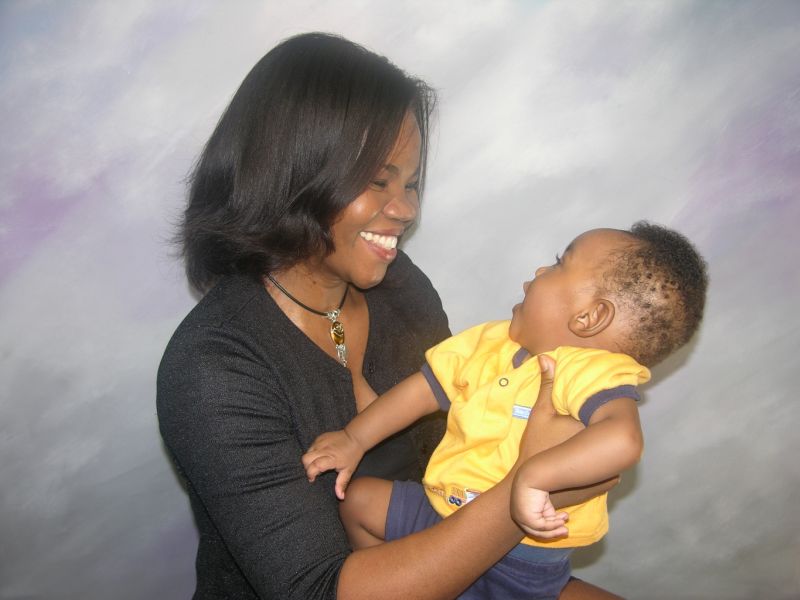
Sixteen-year-old Nathan with his dad, Robert, and their luggage as they prepared to leave Jamaica for the United States in June 2020.
In 2020, my family—my husband, Robert, our four children, and I—arrived in the United States as new immigrants. I was beyond excited. Our three oldest children were already in college, while Nathan, our last-born child, who has a disability, was still of school age. I had great expectations. I believed that gaining access to the US special education system—with its integrated supports, including speech, occupational and physical therapy, augmentative and alternative communication (AAC), and other individualized services—would naturally result in better opportunities and outcomes for Nathan. I believed the system would move him forward.
Nathan was sixteen when he entered the US school system and began ninth grade. He has athetoid dyskinetic cerebral palsy, which causes involuntary movement and spasticity. He is nonverbal and a wheelchair user. Growing up in Jamaica, where he was born in 2004, access to developmental and rehabilitation services for children with disabilities was very limited.
That reality was one of the reasons I established the Nathan Ebanks Foundation in 2007. Through the Foundation, I worked to provide training and developmental support to parents, teachers, and others serving children with disabilities. Most of our partners came from the United States, so I became very familiar with what was possible for children with developmental disabilities in the US special education system through their legal entitlements: early intervention, school-based therapies, assistive technology, Individualized Education Programs, and laws intended to support their meaningful inclusion in the least restrictive environment (LRE).
These were the kinds of opportunities I had been advocating for in Jamaica. Naturally, I was excited that Nathan would now have this access and these rights. The possibility of him entering an educational system equipped with clinical providers, developmental programs, individualized supports, and legal protections was one of my greatest motivations.
We arrived in the United States during the early months of the COVID-19 pandemic lockdown. It took months to make contact with the district’s board of education. This included finding its location, making several trips to the office, and leaving letters on the front porch.
Finally, I was contacted by the director of the Child Study Team, which manages special education services in the school. Nathan’s intake evaluation was scheduled for the end of September—weeks after the start of the new school year.
During his initial evaluation, I noticed that the system operated as if Nathan had been born in the United States, received early intervention, and participated in consistent therapies and educational programming throughout his life. Based on his age, the evaluators appeared to expect a particular level of functioning. The standardized evaluation tools did not seem equipped to account for a sixteen-year-old entering the system after receiving less than two months of speech therapy, three years of physical therapy, and six months of occupational therapy.
The evaluators had no clear way to meet him where he was. When I read the report, much of it was based on what I had shared: “Mother reported” or “Mother stated.”
Looking back, that should have been my first red flag. It should have alerted me that the team would need more help understanding Nathan—his history, his abilities, how he communicated, and how he demonstrated what he knew. It should have told me that more would be needed to ensure his meaningful inclusion.
I Was Waiting for the System to Teach Me

After a year of remote learning during the COVID-19 lockdown, Nathan began attending school in person.
Nathan started school remotely, which he would continue to do for the first year as the lockdown continued. There was no process to educate me about the IEP or teach me how to work with him educationally at home.
When he finally began attending school in person, he was given a nurse aide to attend to his feeding, changing, and care needs, as well as a paraprofessional to provide one-to-one support and help him access learning.
What was noteworthy was the assumption that, although all the professionals who worked with Nathan were formally trained, I, as his parent, would automatically know how to provide this level of support, understand the process, and bring that knowledge to my decision-making.
The teachers, therapists, case managers, school psychologists, and other professionals sitting around the table had been trained to evaluate students, develop goals, measure progress, and interpret data. As Nathan’s parent, I was expected to sit alongside them and participate in decisions that could affect the rest of his life.
I waited patiently for the first two years to be taught. I waited for someone to explain what I should be looking for and what questions I should ask.
What specific outcomes were we working toward? How would we measure whether a strategy was working? What data were being collected? What information should be included in Nathan’s progress reports?
I relied on the system. I attended the IEP meetings and parent conferences. I believed progress would follow.
It didn’t.
I realized that I needed to learn and do more.
Taking My Seat at the Table

The Individuals with Disabilities Education Act requires parents to be members of their child’s IEP team and gives them the right to participate in decisions about their child’s evaluation, educational placement, and services. The purpose of this participation is to ensure that families can share vital information that helps shape an effective educational plan for their child.
Yet, being included on the team did not mean that I had been taught how to participate effectively.
Thankfully, because of my work in Jamaica, I had a village. This included stateside special educators, speech therapists, educational psychologists, and social workers who understood the US system. I began asking questions, researching, reading, and attending training.
One of the books that had been gifted to me years earlier by an extraordinary special education and inclusion specialist, who mentored me for more than a decade, was Wrightslaw’s From Emotions to Advocacy. The book helped me place a framework around the work I was doing in Jamaica. It also expanded my understanding of what was possible for children with disabilities and helped me develop a bigger vision for Nathan.
After those first two difficult years in the United States, I returned to that learning. I purchased two additional Wrightslaw books and later attended the organization’s special education advocacy training.
Each book gave me something different:
-
From Emotions to Advocacy helped me organize my concerns, prepare for meetings, document what was happening, and communicate more strategically.
-
Special Education Law helped me understand the legal foundation beneath the services and protections available to Nathan. I no longer had to depend entirely on someone else’s interpretation of what the school could or could not provide.
-
All About IEPs helped me understand how Nathan’s needs should connect to appropriate goals, services, supports, and measurable progress.
As my understanding grew, the way I participated began to change.
I leaned more confidently into what I knew about Nathan—how he learned, how he communicated, and which strategies helped him engage. I began asking how progress would be measured and what data would be collected. If I could see that something was not working, I called an IEP meeting rather than waiting for the annual IEP review.
After a while, I noticed that members of the Child Study Team and the school team began arriving at our meetings with notepads. They knew I would come with observations, questions, and recommendations.
I was no longer waiting for the system to tell me what Nathan needed. I was sitting in my seat of partnership around the table.
The Shift for Nathan—and for Other Students
By participating more actively, I was able to bring what I knew about Nathan into the process. As families, we carry important knowledge about our children’s behavior, history, needs, and lives outside the school environment.
That shift did not benefit Nathan alone. His experiences revealed gaps in the implementation of services across the school’s systems, and some of the changes made in response would later support other students.
One example was the introduction of a wheelchair clinic.
I explained to the school and the district that a wheelchair is not simply a piece of equipment. For a student like Nathan, it provides mobility, positioning, and access to his educational environment. If something happens to the wheelchair and there is no process for addressing it, the student’s ability to participate in school is immediately affected.
Through continued discussion and advocacy, a wheelchair clinic was eventually offered through the school. More individualized programming was also developed for students who are nonverbal and unable to communicate consistently through speech.
The system Nathan entered was not automatically prepared to meet all his needs. But as I became better prepared to participate, we were able to work with the school to improve his experience and help create a better landscape for some of the students who came after him.
You Have a Seat at the Table
The lesson I learned is that, as parents, we carry knowledge about our child that no degree, evaluation, or job title can replace.
The IEP is a tool within a much larger educational framework. What is written on paper becomes meaningful only when it reflects the child’s needs, guides the services being provided, and holds everyone accountable for monitoring progress.
As we prepare for another school year, I encourage you to take one step toward becoming better informed. Explore the three Wrightslaw books that helped me: From Emotions to Advocacy, Special Education Law, and All About IEPs. You can find them through the official Wrightslaw website.
Then find yourself in the company of other parents who are discussing these issues and helping one another apply what they are learning. Information can tell us what exists, but education helps us understand what to do with it.
If you are ready to deepen your understanding and participate more confidently in your child’s education, I invite you to join us inside the Mama Bear Collective.
It has long been my belief and experience that we are stronger together. You do not have to learn how to navigate the system alone.